← Artists


Sander Reijgers
Sander Reijgers’ artworks are the result of a long, painstaking process carried out with
the utmost patience. The coloured surfaces harbour numerous superimposed layers
of paint; the cumulative effect of their individual drying times creates a tangible
history that often spans several years. Reijgers’ work reveals a fascination with the use
of materials and the act of painting itself, potentially reminding the observant viewer
of the Action Painters of Abstract Expressionism. After all, that movement is
grounded in the practical, physical act of painting: the gesture of creation is
transferred to the canvas through a spontaneous record of the artist’s activity. The
resulting artwork serves primarily as a reminder of the artist’s action in time and
space; the focus is not on depiction itself, but on documenting the artist at work.
Reijgers’ compositions can also be viewed as veritable time capsules, records of the
creative process, yet they differ from the work of the Action Painters in one crucial
respect. While their paintings are the product of spontaneous action, Reijgers arrives
at his creations through a highly deliberate approach.
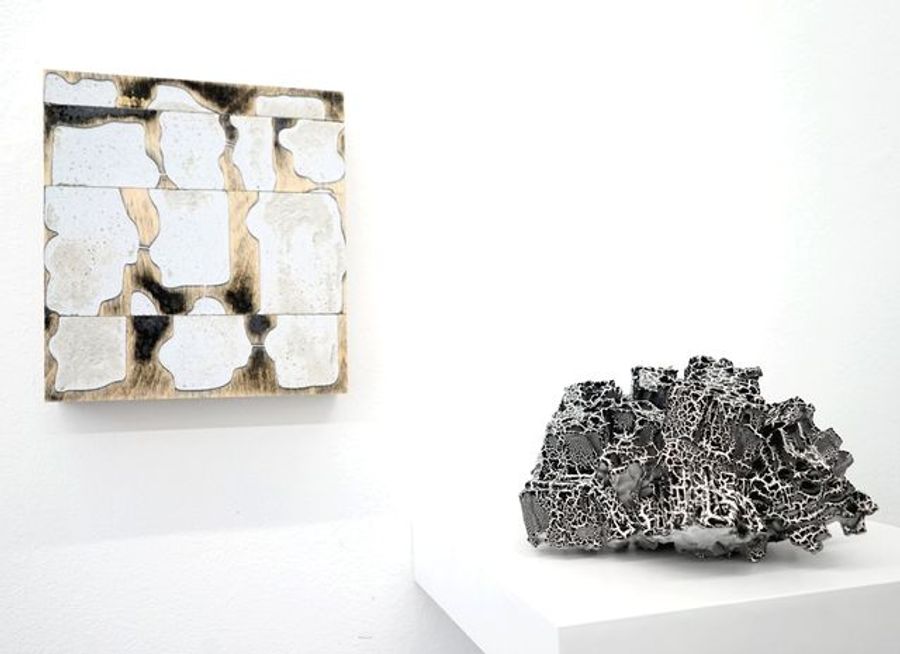
Surface, paint medium and application, colour, and time are the guiding variables in
Reijgers’ art, forming the literal and figurative frameworks within which he operates.
The natural interplay between these factors gives rise to the structure’s characteristic
of his work, requiring him to willingly surrender to their autonomous interaction. The
resulting compositions are, therefore, not merely the product of the artist’s own
actions, but also of the properties inherent in the materials and the circumstances in
which he employs them.
These organically evolved structures also invite the viewer to look at painting in a
different way: our attention is not confined to the surface at the front of the canvas;
the edges and sides must also be examined to gain a full understanding of Reijgers’
creative process. In this way, the painting’s traditional central pictorial plane is
expanded to include the ‘periphery,’ which is of equal importance here. Moreover, the
work’s three-dimensionality transcends another long-standing divide in the visual
arts: the distinction between painting and sculpture. Sander manipulates his painting
material almost as a sculptural medium, a substance that extends not only in height
and width but also in depth. The result is an eccentricity that radiates into every part
of the space.
Exhibitions & Art Fairs
Works